
Durham Tech opens state-of-the-art immersive room, ambulance simulator for EMS training
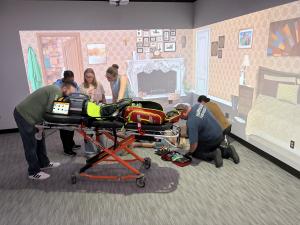
Durham Tech’s nationally recognized Emergency Medical Services (EMS) program has unveiled a new state-of-the-art immersive room and ambulance simulator at the Orange County Campus that are designed to provide students in the EMS program with realistic, high-pressure emergency response training.
The new training environment allows instructors to re-create a wide range of emergency scenarios by altering lighting, temperature, sounds, surroundings, and even smells to mirror real-life situations EMS workers and paramedics encounter in the field. Students can respond to simulated car crashes, natural disasters, cardiac emergencies, active scenes, and in-home medical crises while learning to remain calm and focused under pressure.
“The room is a stress inoculation. A classroom that pretends to be the world,” Steve Wilson, EMS Program Director, said. “We can even add in video we take and input, meaning, students will see Orange County and Durham County landmarks, along with other regional locations — specific areas that they recognize and may go to once out in the field. We get them comfortable at being uncomfortable.”
The Orange County Campus also has added a fully equipped ambulance simulator that re-creates the challenges of providing patient care while in transit. The simulator can mimic the motion and vibration of an ambulance on the road and includes shock capabilities that simulate potholes, abrupt stops, and uneven terrain.
“This immersive learning environment gives our students an opportunity to train in conditions that closely resemble what they will experience on the job,” Wilson said. “By exposing students to realistic sights, sounds, movement, and distractions, we are helping them build confidence, critical thinking skills, leadership skills, and the ability to deliver quality patient care in high-stress situations.”
The immersive room is designed to support both EMS and paramedic students as they practice assessment, communication, teamwork, and emergency interventions before entering the workforce.
The technology enhances traditional classroom instruction by allowing students to experience the unpredictability of emergency responses while learning in a safe, controlled setting.
“Emergency medicine is rarely quiet or predictable,” said Justin Davis, EMS Clinical Coordinator. “Patients are treated in cramped spaces, moving vehicles, dangerous weather, and emotionally charged situations. This technology prepares students for those realities while strengthening their technical and decision-making skills.”
The new facility reflects Durham Tech’s continued investment in workforce training and public safety education. The College’s EMS program has earned recognition for preparing highly skilled first responders who serve communities across the Triangle and beyond.
Students training in the immersive room will encounter scenarios that require rapid decision-making, patient stabilization, and communication with fellow first responders — all while adapting to environmental distractions and changing conditions.
The ambulance simulator also allows instructors to pause and replay scenarios for real-time feedback and skill development.
“This is about creating the most authentic learning experience possible,” Wilson said. “When our graduates respond to emergencies in the community, we want them to feel prepared because they have already trained through realistic situations here at Durham Tech.”
The immersive room and ambulance simulator are now fully operational and integrated into EMS and paramedic instruction.