
Students shine at fall 2025 Honors Symposium
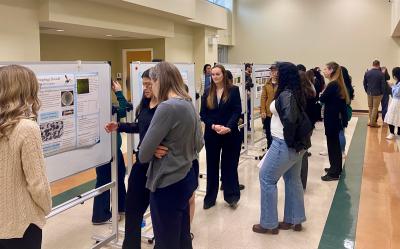
Durham Tech’s Honors Program students recently presented their research at the fall 2025 Symposium.
“The honors program gives students the opportunity to engage in self-directed learning that goes beyond the scope of a particular course. It is a phenomenal opportunity to become more familiar and practiced with techniques and practices within a discipline and collaborate more closely with their instructors and peers,” said Dr. Alex Broussard, Durham Tech instructor and Honors Program co-director.
Josh McMenemy, who completed his fourth honors project and earned the Honors Scholar designation, was one student recognized at the Symposium.
“Those students who successfully complete honors projects are recognized for their work by being awarded honors credit for the corresponding course, and those that complete four research projects prior to graduation are offered the designation of honors scholar, which comes with a medal, a special recognition at the symposium, and a cord denoting their status at graduation,” said Amy Pine, Durham Tech instructor and Honors Program co-director.
Many students in the BIO 111 SEA-PHAGES class, led by Broussard and Dr. Marie Fogarty, earned honors designation for their research. Students isolated new bacteriophages (viruses that infect bacteria) and characterized them in the lab using microbiology and molecular biology techniques. Those earning honors designation were Annabelle Fox, Cristal Gomez-Perez, Julia Jackson, Kimberly Lemos, Matthias Mathieu, Tarek Slater, Avery Soular, Chanelle Swepston, Hakan Teemojin, Jamia Whitted, and Bridget Williams.
Daniel Kretschmer and Zongyao Wang earned honors credit for their SEA-GENES research in BIO 250, working with Dr. Catherine Ward on cloning and analysis of genes found in the bacteriophage Mabel.
The following students conducted honors research under the guidance of their instructor:
- Nancy Rosales, working with Dr. Catherine Ward, used survey data to ask whether the number of hours a person sleeps influences memory and reaction speed.
- Stella Makunzva, working with Dr. Alex Broussard, focused on construction of an inducible gene expression vector for fluorescent yeast.
- Mishelji Arguelles Hernandez, working with Dr. Patrick Coin, conducted research centered on developing a sustainability initiative geared toward maximizing public awareness and identifying opportunities for climate resilience.
- Angelina Singotiko, also working with Coin, compared morphological approaches and habitus-based computer vision tools in identifying North Carolina arachnid species.
- Shoon Lai Paing, working with Marta Carron Delgado, focused on how cultural exchange, historical trade, and migration have influenced the language and content of Spanish cuisine.
- Precieux Kounieka worked with Catherine Thomas to explore the Brachistochrone Problem, which describes how a body travels under the influence of gravity along different paths.
- Alexandra Moncada and Rachael Childres, with guidance from Dr. Eric Punkay, evaluated the success of a plant restoration project at Brumley Nature Preserve by measuring the prevalence of native and invasive species after a native planting intervention.
- Diana Rocio Vazquez, working with Dr. James DePalma, focused on the Mexican-American War and the influence of this conflict in modern political dynamics.
- Zhiliang Hu, with Dr. Christopher Mansfield as his instructor, researched singular value decomposition.
- Landon Silverman, working with Dr. Darryl Bing, studied how antioxidants such as vitamin E can impact the process of agglutination in erythrocytes by oleic acid.
- Susan Hansen, also working with Bing, evaluated cooking oils for their oleic acid content and ability to induce agglutination in erythrocytes.
- Ler Moo, also working with Bing, compared the use of ketogenic and gluconeogenic amino acids as a feedstock for generating potential in a microbial fuel cell.
- Emily Spencer, with guidance from Linda Shostak, focused on understanding the relationship between contract research organizations and sponsors in clinical research.
- Josh McMenemy and Dex Aucoin, Dr. Eric Punkay’s class, studied the ability of the slime mold Physarum polycephalum to optimize paths between different food sources during growth.
- Eliana Bruce, in Kim Green’s class, focused on the development and history of the motherboard, specifically as used in PlayStation gaming consoles.
- Quyen (Lisa) Bui and Habeebah Hasan, also working with Green, researched the history of portable computers and the technological advances that have enabled their implementation.
- Fernando Fajardo, working with Green, investigated improvements in efficiency and health through ergonomic-focused interventions around keyboard usage.
- Spencer Covert, another student in Green’s classes, focused on the development of an application for backing up hard drives as compressed folders.
- Thi Nguyen, with guidance from Dr. Pamela Dezurik, explored the relationship between tongue cleaning, oral microbiome, and regulation of blood pressure.
“Communication with both academic peers and the larger community is integral to scholarship in all fields, and the honors symposium gives every student the opportunity to share their work and expertise with a diverse audience,” Pine said.